Case study
Where does the time really go
in a firm of 40 employees?
An accounting firm of 40 employees, spread across 3 offices, with two days of remote work a week. Here is how an OpusRH rollout unfolds: the problem it starts from, the first six weeks, what the measurement brings to light — including what surprises a management team — and the decisions that can follow.
The context
A management team deciding blind
The company
40 employees: 28 accounting staff, 6 assistants and 6 support roles. Three offices, 60 km apart. Since 2021, two days of remote work a week for every role that allows it.
The trigger
Two partners disagree. One wants to cut back remote work, convinced that output drops on Tuesdays and Fridays. The other argues the opposite. Nobody has a single figure. The debate has been running for eight months and is poisoning partner meetings.
Week 1
Setting the framework before measuring
The technical rollout takes half a day. The social framework takes a week — and that is the part that decides whether the project succeeds or fails.
Information and consultation
Management hands employees and the works council the exact list of what is measured, taken straight from the documentation: activity counters, foreground application, window title, session state. And the list of what is not: no screen capture, no keystrokes, no browsing.
Working hours and scope
One company-wide schedule (9:00–12:30 / 13:30–17:30), refined by group for the office that opens earlier, and two part-time employees set individually. Three groups created: Production, Assistants, Support.
Rolling out the fleet
The installer, generated from the console with the firm's key already embedded, is deployed silently by the IT provider. 40 workstations report in within the hour. Employees have nothing to do.
Weeks 2 to 4
What the data showed
Three findings, two of them the opposite of what everyone believed.
Remote work was not the problem
The activity rate on Tuesdays and Fridays comes out 2 points above the average for days spent in the office. An eight-month debate is settled in three weeks — and not in the direction the more convinced partner expected.
Meetings were eating the mornings
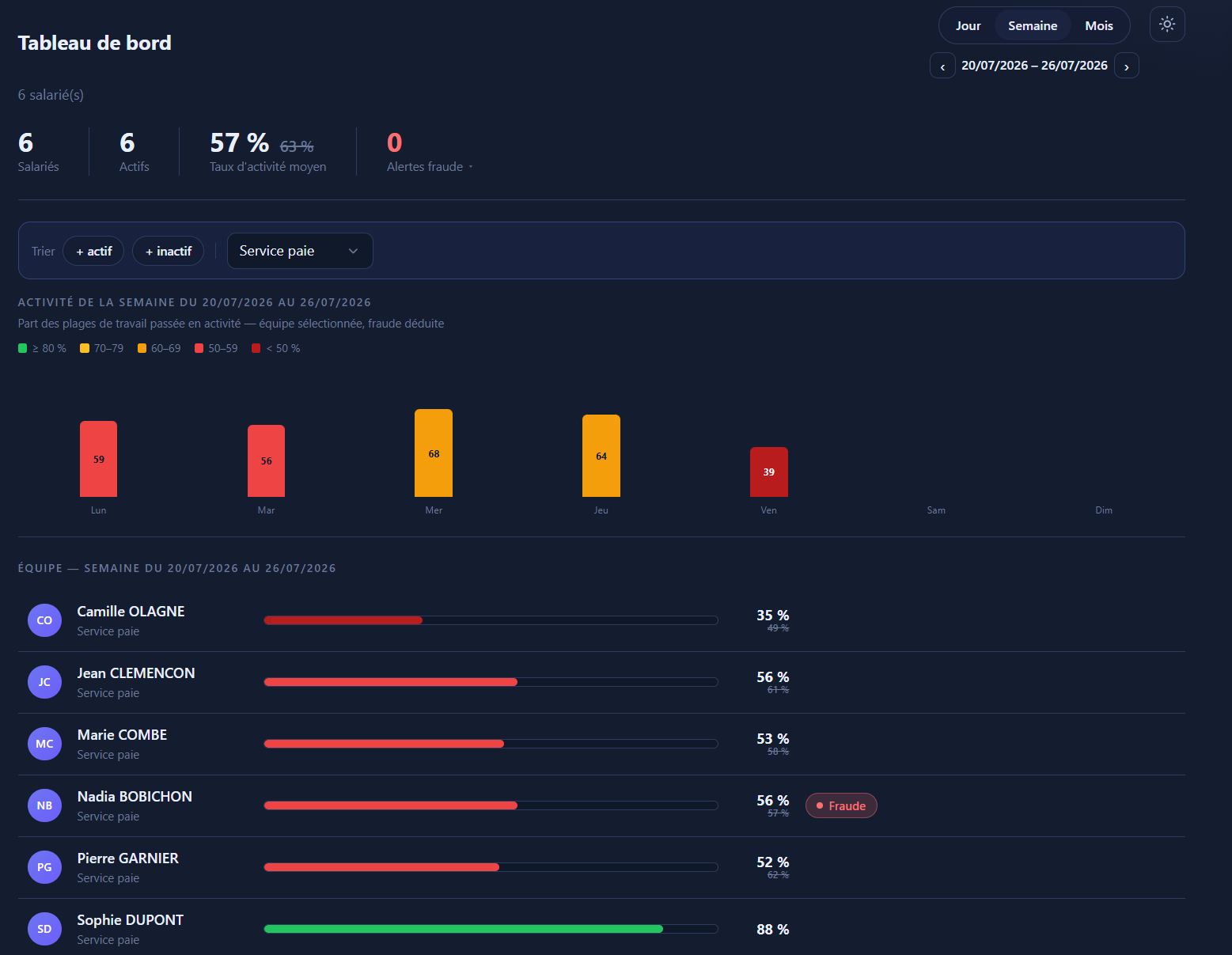
The hourly view shows a systematic dip between 9:00 and 11:00. The blue line marking video calls explains it: team meetings stacked at the start of the morning, in the slot where concentration is at its best.
One office was falling behind
One office shows 11 points less than the other two. Opening the individual profiles, the explanation is not a human one: a business application freezing several times a day, which nobody had reported because “it had always been like that”.
Weeks 5 and 6
The decisions
No sanctions, no disciplinary interviews. Three organisational decisions, taken on data nobody disputed — because everyone could open their own day and check.
Remote work kept
The matter is closed and the debate in partner meetings stops. The firm shares the figures internally, which defuses the rumour that “remote work was about to be scrapped”.
Meetings moved
Team meetings move from 9:30 to 14:00. The 9:00–11:00 slot is ring-fenced for production. The morning dip disappears from the histograms within two weeks.
The business application fixed
The provider is chased with precise dates and times of freezes rather than a vague “it's slow”. The fix arrives in ten days; the gap between offices falls to 3 points.
Three months on
What the firm does with it today
A weekly ritual, not surveillance
Every manager gets the weekly report on Monday morning. They read it in five minutes, spot the gaps, and only open the detail if a figure raises a question. The dashboard is not consulted daily — and that is not the point.
Anomaly detection, switched on in month 4
Once trust was established and the system accepted, management switched on simulated presence detection. Two cases flagged in six months, both explained by legitimate use after discussion. The tool flags; the human decides.
Real-time tasks in a single department
The Time tracking module is switched on for the assistants only — 6 people — where the split between client files was the least clear. The other 34 employees do not have the desktop bar: activation is done group by group.
One departure, one anonymisation
An employee leaves the firm. Thirty days after their last activity, their record is anonymised: identity and window titles erased, licence released. The historical volumes for their team stay accurate.
Key takeaways
What this case says about the product
- Measurement settles debates of opinion. Eight months of discussion between partners closed by three weeks of data nobody disputes.
- The problems that surface are rarely about people. Of three findings, two were about organisation and tooling; only one could have been read as a people problem — and it was not one.
- The social framework comes before the tool. Information, consultation, fair working hours: without them, the figures are contested and the project dies.
- An unfair measurement is worse than no measurement. Counting a video meeting as inactivity would have discredited the whole thing in the first week.
- Switch things on gradually: measurement first, anomaly detection next, time tracking only where it earns its place. Nothing is imposed all at once.
And in your organisation, where does the time go?
A 15-day trial with your real teams, no credit card. Deployment takes half a day.